To get the Hobart, Tassie's capital, I flew through Melbourne. My Cairns to Melbourne flight got in late at night, and being stingy, I decided to forgo a real bed for the night and just sleep in the airport (my flight left at 6 the next morning). I didn't sleep real soundly, but I think it was the best way to go, because I saved not only the $25 for a room, but $20 for the shuttle bus, not to mention the stress of hauling my bags all over the place.
Getting in to the Hobart airport, the very first thing I saw was sniffer dogs. Like several other states, Tassie enforces a quarantine on fruit products coming into the state. Unlike the other states, Tasmania seems quite serious about enforcing their rules. They had adorable sniffer beagles sniffing all the incoming people and baggage. Awesome.
After dropping stuff off at my hostel, I decided to explore the city. Hobart is a very pretty little city nestled in amongst tree-covered hills and a large natural harbor that services a lot of antarctic expeditions. It also feels a bit more historic than most Australian cities. Maybe it's just the sandstone construction that dominates most of the architecture, or maybe it's their weird statue obsession, but Hobart actually feels like it's seen some things in its time, unlike most of the other Aussie capitals, which could have been plopped down two weeks before. I walked along the harbor, which hosts everything from little fishing skiffs to a massive antarctic expedition cruiser to floating fish 'n chips shops, the IXL Jam Factory, so named like a century ago by the owner, who wanted to make it clear that he excelled at everything (get it? yeah, apparently puns aren't a new phenomenon), and a ton of sculptures. Really, I don't know why, but Hobart has to have about 1.3 statue installations per capita. They even erect statues, and then later add on to them and slap a second plaque on to commemorate the addition.
Back at the hostel, I talked to a Frenchman who had just gotten back from circling the island with a German and an Australian who he had met a couple days before, and also a South Korean who had flown in yesterday. That was about it for excitement that evening. The weird thing about Hobart is that even though it's a sizable city with a perky downtown district, absolutely everything closes down at 6pm. Even the restaurants. It's weird.
Friday, after packing up and shopping, I ate lunch in a rose garden, then hired a bike and pedaled via the Derwent River to the suburb if Glenorchy, which was constructed to house the workers at the Cadbury's chocolate factory located on the scenic peninsula overlooking the river. I also biked across the Tasman bridge, a massive bridge that apparently needs to get even taller from time to time, since it's a drawbridge. After that it was time to catch the coach bus to Lake St. Clair, the end point for Tasmania's wildly popular Overland Track. I wasn't hiking the track due to lack of time (it takes something like six days), but the area offered some nice day hikes, and I really wanted to see some of the wilderness that Tasmania is so popular for. The hostel (really just a bunkhouse as part of the larger campground, oddly enough, was one of the nicest I stayed at. It had a very nice kitchen area, good ambience, and I got a room to myself (thanks to the fact that it wasn't yet peak tourist season). Walking outside, I saw what at the time I thought was the fattest wallaby and joey ever. turns out it was actually a pademelon (which I didn't yet know existed). Eating dinner I talked to a very nice couple from Sydney who were making their way around Tasmania on holiday. Sitting around after dinner, I glanced out the window, only to find a possum looking right back at me with his nose pressed to the glass.
At some point it occurred to me that it was raining steadily and I had left my rain jacket in Hobart. I had also left my chlorine pills and flashlight, all of which I had not and would not need at any other point on the trip except while at Lake St. Clair. Brilliant.
The next day, after talking to a ranger at the visitor center, I set off for Shadow Lake and Mt. Rufus. It was still raining steadily, although not very hard, which was good, because any downpour would have soaked right through my hoodie/long underwear combination. Going up, the trail was frequently a stream. Not a trail with a rivulet of water running down it, no, they were directing us to walk up streambeds. At some point, the lush rainforest started giving way to eucalypt forest and scrubbier foliage, and the rain turned to snow. By this time I had taken up with a group of three who were also aiming for the summit of Mt. Rufus. They were, of course, far better equipped and experienced than me.
After a bit more walking, we hit the ridge climbing up to the summit. Now, when they had said Mount Rufus, I hadn't quite understood what they meant. Our hikes in South Australia had gone over some mountains, but there "mountain" meant "a bit of a climb and then a nice view." Turns out in Tasmania, "mountain" means "terrible visibility, gale-force winds, blowing snow that feels like pinpricks on any exposed skin, deep snowdrifts, cloud cover that blots out the sun and everything else, and poorly marked paths." Who knew? Thankfully, my long underwear actually kept me quite warm, although it would have been nice to have some gloves, and something to protect my face from the biting snow. After a while of this, we reached a high point, and decided that it seemed to be the summit, and perhaps the marker had just been buried by the blizzard in progress. The trail continued down the other side, but the hikers I was with turned back, telling me about the time they had misjudged a distance and ended up weathering a night on a mountain with no tent or sleeping bags ("I don't reckon I want to do that again," said one). I kept going down the other side. Why? Because I'm dumb. A little while later I reached the actual summit, which was marked with a massive cairn. There was one worrisome moment where I briefly lost the trail, but after not falling down the side of the mountain and backtracking a little, I found it again, and soon I was descending out of the blizzard.
Through the occasional breaks in cloud cover, I had been catching absolutely amazing views, and once I was out of the mist, the scenery hit full force. I had heard a lot about how pretty Tasmania was, but this hike was what really drove it home. I was literally stunned by how beautiful the area was. Also amazing was the sheer variety of things to see. From the barren summit, I descended into a mossy forest full of weird palm-like plants, then back into thick rainforest, then into a swampy plain, and finally back into eucalypt forests again. To illustrate in another way, I encountered the following forms of water: rain, hail, snow, lakes, ice-crusted rocks, bubbling brooks, rushing rapids, a spring burbling up right next to the path, and an underground stream (which for some reason the path walked on top of for a while).
I was incredibly glad that the waterproofing on my boots held out through the summit section of the hike, but at some point on the way back down it finally gave up, so by the end of the hike my feet were pretty wet, and I was eager to get back home. Still, I couldn't resist a short detour to Platypus Bay, so named because platypi sometimes come there to feed, and lucky hikers might get to see one. I stood there for quite a while watching the bay, and while I did see a fat pademelon feeding on the shore, there were no platypi to be found. Finally, I gave up and turned for home. As I glanced out for one last look, a rock that I didn't remember seeing before caught my eye. I turned to look, and sure enough, a couple seconds later it disappeared under the water. Holy crap I saw a wild platypus! I watched for a long time as the platypus would dive underwater to feed, then return to the surface to chew its food. I was really excited, and felt very lucky to have gotten to see it (to give you an idea, I was the first entry in two days in the logbook for platypus sightings at the visitor center).
Ok, turns out I have a lot to write on Tasmania, so I'm going to cut off and put up what I've got so far to satisfy the less patient among us. Check back in a week or so for the rest of my Tasmania adventures, and at some point beyond that, the rest of Sydney.
Saturday, January 27, 2007


Thursday, January 18, 2007
Cairns!
Photos!
Cairns is the tropical region of Australia. It reminded me of Florida in that it's a place where Mother Nature has made it more than clear that humans should not be living... and yet we stubbornly move in anyways. Let's see, besides the usual Aussie potpourri of snakes, spiders, massive sharks, poisonous fish, and vicious UV rays, Cairns boasts the further benefit of enormous crocodiles (7 metres?!!), and jellyfish that spend all summer washing up all over their beaches. So yes, throughout the hottest, most humid half of the year (and believe me, it is very humid), the water is deadly. Brilliant.
So then, you ask, why were we dumb enough to go to Cairns? Well, the main attractions are the Great Barrier Reef and tropical rainforests the edge the city. And as much as I've failed to pitch it, Cairns is a perfectly decent place to vacation, although I would never ever want to live there.
Saturday morning we walked into Cairns' downtown district, perused the shops (all rather touristy, though we did get some tasty gelato), and then walked up and down the waterfront. The city looks out over a beautiful bay, although of course you can't go in for a quick wade unless you want to chance being eaten by a giant crocodile (there are warning signs all along the path). Still, it's a very pretty waterfront with nice parks and a saltwater swimming pool for the kiddies. The afternoon we spent hanging out at the hostel and planning the next few days' activities. The hostel was very nice, and despite being basically the same price as the others we had stayed at, had nicer rooms, its own small swimming pool, and a free nightly movie. Over dinner we talked with a nice old couple from Melbourne vacationing for the week. They came down every night to have a beer and watch the movie, so we compared notes with them each following evening.
The next day was rainforest day. We go a package that took us up to the town of Kuranda via a Skyrail through the rainforest (built to minimize the environmental impact). There were intermediate stops to walk around and look at the rainforest, and at one of those stops we got a guided tour from a park ranger who was quite possibly insane. Good times. Kuranda itself was overly touristy, but we had a good time wandering around and browsing all the shops (also we enjoyed a delicious chocolate milkshake). The trip back down was by a scenic train, originally built to get supplies to some foolish inland colony (once again, I really don't get why anyone thought "hey, let's settle here!"). It was built entirely by hand, and seven men died during its construction. These days it takes tourists, still traveling the original route, which was very pretty, sometimes tunneling straight through the mountain when they couldn't get over or around.
The next day we set off on our chartered boat for snorkeling on the Barrier Reef. Somehow we got very lucky on our choice of touring companies. Most reef charters are big electric, air conditioned catamarans (boooring). Ours was the Falla, an old wooden number that looked a little like a pirate ship and traveled most of the hour and a half journey to or from the reef under sail power alone. Way cooler.
On the way out, in the middle of the safety presentation, a peg that the foremost sail was roped to broke in half, leaving the sail flapping in the wind with the rope whipping around viciously at the end. So our crew had to interrupt the talk to pull the sail back in, then two of them threw their weight into holding it in place while the third pried out the splintered bits of peg with a screwdriver and replaced it with one from the other side of the boat. Was anyone steering while this was going on? Possibly the thirteen year old tourist, who they let steer for most of the return trip.
Later in the day, the crew related the story of the Falla's origins, which are as follows. It was built originally to harvest mother of pearl from the giant clams. Next it got a license for profitable lobster harvesting. When it got too old and outdated for commercial work, it was bought and used in a reenactment of the First Fleet (Captain Cook's expedition) and sailed to Sydney. That owner lost it in a game of cards (no seriously) to two Italian brothers, who sailed it as far as the Cairns area, ran out of money, and then realized they could turn a profit by chartering it out to tourists. It stayed in the charter business until 2002, when it hit a reef and sank to the bottom of the ocean(!!). It was hauled in and probably would have gone to scrap had a former crew member not bought it and rebuilt it, becoming the new captain. So yeah, we sailed out to the reef on a boat that had spent time on the sea floor.
Anyways, the reason we were on the boat, seeing the reef, was fantastic. We spent quite a few hours snorkeling, and got to see a ton of cool stuff. We saw sea turtles, and eel, an octopus, rays, sea slugs, and giant clams. Oh, and Katherine "found Nemo" (i.e. a tiny clownfish). The guides found a rather large "gummy shark" hiding in a cave near where we had anchored, but it was too deep to see without scuba gear. Also, on the trip out we happened across a school of tuna under attack by a shark. The tuna were leaping out of the water all over the place, and for some reason had attracted a flock of gulls who were circling and swooping. Katherine and I decided we were really okay with not actually seeing a shark while we were swimming around (Katherine: "I would have peed in the water"). All in all, it was a most excellent outing. I think my favorite part was the giant clams. To be honest, I never realized they actually existed in real life. And they are huge. I mean, those things could swallow me alive if they were so inclined.
Tuesday we took a bus up to a beach north of the city. Beaches are where Cairns residents happily congregate to enjoy all of the deadly things the area has to offer, all in one convenient location (don't worry, even the crocodiles are known to go for swims in open sea when they feel like it). If you go in the water, you run the risk of getting plastered by the box jellyfish, which is by all accounts indescribably painful, not to mention possibly deadly. There are nets strung around the popular beaches to prevent this, but don't worry! There's another jellyfish, the Irukandji, which is small enough to get through the holes in the net, and is also horribly venomous. But yeah, we had a good time at the beach, by which I mean we didn't die or contract skin cancer (hopefully).
The next day Katherine had an earlier flight back to Adelaide (via Melbourne), and then home, while I was continuing on to Tasmania. We split a cab, I checked my luggage early for my evening flight, and I saw Katherine off. Then, too cheap to pay for another cab (no public transit runs to the airport), I hoisted my backpack and set off walking on the road out of the airport. Turns out it's a very long walk out. Still, I was glad I had walked, because halfway out I stumbled across a boardwalk into the mangrove swamp that surrounds the airport. I had never been in a mangrove swamp before, so it was a very new experience. The mangrove trees themselves are very crazy-looking, and there are little creatures all over. Mostly I saw tiny crabs that eat decomposing leaves, but there were also a massive white bird, and mysterious conical shells that didn't seem to have anything living in them, and yet moved slowly across the ground.
After that I continued my hike along the road until I made it to the Mount Whitfield conservation park. The area is ecologically isolated, making it home to lots of weird species of animals and such, like the cassowary. It's a bird, and yet it's dangerous and unpredictable, and sometimes attacks humans. What is wrong with this country? Highlights from the warning sign about cassowary attacks at the beginning of the trail included "Do not run away, this will expose vulnerable areas of your body to the bird's attacks" and "If you have a backpack or jacket, use it as a shield." I had a pleasant hike up part of Mount Whitfield, got some nice views, saw a ton of ugly turkey-things and less ugly quail-things. Then I grabbed some dinner and hiked back to the airport for Tasmania!
Monday, January 08, 2007
Sydney!
Photos!
This part of our trip started off eventfully when our train was stopped for 2 hours in the middle of the night because there were bushfires threatening the tracks up ahead. I guess the bushfires moved on or changed directions or something, because after that the ride went smoothly. We got in to Sydney around 9am, so we hopped a train (Sydney's public transport is a combination of trains, buses, and ferries) to our hostel in King's Cross, another former red light district. I really can't explain how we kept ending up in hostels in formerly seedy districts. I think Katherine has a latent talent for these kind of things. Probably tied into her creepy talent for finding people in random places (for example, finding Kyle in a Melbourne street, and finding both Cassie and me at separate times in airports on the trip over, even though we weren't on the same flights as her).
After dropping our bags at the hostel, we walked down to the Sydney Royal Botanic Gardens. The gardens were very nice, and are situated right on the edge of the harbor, making for some excellent views. We saw a positively enormous spider near the bathrooms, sat in a stone chair on a point that a former governor's wife apparently sat in every day to survey the harbor, and ate a picnic lunch of pita, hummus, and chocolate milk. After that we walked towards the Opera House, which is situated right next to the gardens. We walked around, took the requisite tourist photographs, and continued on down the quay, which houses a lot of shops and restaurants, and is the launching point for most of the ferries to other places. Then we went shopping and returned to the hostel, where we gorged ourselves on nachos. So many nachos...
The next day was museum day. First up was the Maritime Museum. The exhibits inside covered just about everything that involved Australia and water. They had a lot of cool original artifacts, like the boat used by the first lady to circumnavigate the globe, a boat made from beer cans, and "Spirit of Australia," the fastest boat in the world. That last one was especially fun because it turns out water speed record contenders are absolutely off their minds. The guy who built Spirit of Australia is a "self taught" mechanic. Who installed a jet engine in his boat. And most people who attempt to break the record die. Other good exhibits were one on the guy who spent 7 years in a collapsible kayak (making it from Germany to Australia), and a pirate exhibit aimed at small children that included a full-sized mannequin hanging from a full-sized gallows, and a motion-activated video ghost of Blackbeard that scared the crap out of me. How is that appropriate for kiddies?
Having spent hours in the museum looking at pretty much everything (Katherine is [un]luckily as big of a nerd as I am), we weren't even done yet. We still had to see the main attractions, a full replica of Captain Cook's Endeavour (the boat he "discovered" Australia in) and a decommissioned submarine, both docked in the harbor right outside the museum building. The Endeavour turned out to be very interesting, in large part thanks to the friendly volunteer guides who told us all about it. It's a "full" replica, right down to the plates in the galley, which are made of pewter. The only exception is the modern navigation/communication gear installed in the hold. And why do they have all that gear? Why, because they sail the boat to other cities/countries from time to time. And if you pay enough, you can buy passage along with them, including a hammock spot in the sleeping quarters. What the crap?! The submarine was also pretty neat. We got to look through the periscopes (they have a 'search' periscope and an 'attack' periscope for different situations), poke at all the machinery, and read the duty rosters and stuff that were still there from the last trip it took. It was every bit as cramped and claustrophobic as you might think. I was reassured to hear that they don't still take the sub out for voyages.
Having spent far, far longer than intended in the Maritime Museum, next it was on to the Sydney Aquarium. Highlights:
The next day was our last in Sydney, so we decided to go to the famous Bondi Beach. It turned out to be quite enjoyable. We sunbathed, bodysurfed, and occasionally got battered and swamped by the waves. Then we hopped a bus right from the beach to the airport and were off to Cairns.
This part of our trip started off eventfully when our train was stopped for 2 hours in the middle of the night because there were bushfires threatening the tracks up ahead. I guess the bushfires moved on or changed directions or something, because after that the ride went smoothly. We got in to Sydney around 9am, so we hopped a train (Sydney's public transport is a combination of trains, buses, and ferries) to our hostel in King's Cross, another former red light district. I really can't explain how we kept ending up in hostels in formerly seedy districts. I think Katherine has a latent talent for these kind of things. Probably tied into her creepy talent for finding people in random places (for example, finding Kyle in a Melbourne street, and finding both Cassie and me at separate times in airports on the trip over, even though we weren't on the same flights as her).
After dropping our bags at the hostel, we walked down to the Sydney Royal Botanic Gardens. The gardens were very nice, and are situated right on the edge of the harbor, making for some excellent views. We saw a positively enormous spider near the bathrooms, sat in a stone chair on a point that a former governor's wife apparently sat in every day to survey the harbor, and ate a picnic lunch of pita, hummus, and chocolate milk. After that we walked towards the Opera House, which is situated right next to the gardens. We walked around, took the requisite tourist photographs, and continued on down the quay, which houses a lot of shops and restaurants, and is the launching point for most of the ferries to other places. Then we went shopping and returned to the hostel, where we gorged ourselves on nachos. So many nachos...
The next day was museum day. First up was the Maritime Museum. The exhibits inside covered just about everything that involved Australia and water. They had a lot of cool original artifacts, like the boat used by the first lady to circumnavigate the globe, a boat made from beer cans, and "Spirit of Australia," the fastest boat in the world. That last one was especially fun because it turns out water speed record contenders are absolutely off their minds. The guy who built Spirit of Australia is a "self taught" mechanic. Who installed a jet engine in his boat. And most people who attempt to break the record die. Other good exhibits were one on the guy who spent 7 years in a collapsible kayak (making it from Germany to Australia), and a pirate exhibit aimed at small children that included a full-sized mannequin hanging from a full-sized gallows, and a motion-activated video ghost of Blackbeard that scared the crap out of me. How is that appropriate for kiddies?
Having spent hours in the museum looking at pretty much everything (Katherine is [un]luckily as big of a nerd as I am), we weren't even done yet. We still had to see the main attractions, a full replica of Captain Cook's Endeavour (the boat he "discovered" Australia in) and a decommissioned submarine, both docked in the harbor right outside the museum building. The Endeavour turned out to be very interesting, in large part thanks to the friendly volunteer guides who told us all about it. It's a "full" replica, right down to the plates in the galley, which are made of pewter. The only exception is the modern navigation/communication gear installed in the hold. And why do they have all that gear? Why, because they sail the boat to other cities/countries from time to time. And if you pay enough, you can buy passage along with them, including a hammock spot in the sleeping quarters. What the crap?! The submarine was also pretty neat. We got to look through the periscopes (they have a 'search' periscope and an 'attack' periscope for different situations), poke at all the machinery, and read the duty rosters and stuff that were still there from the last trip it took. It was every bit as cramped and claustrophobic as you might think. I was reassured to hear that they don't still take the sub out for voyages.
Having spent far, far longer than intended in the Maritime Museum, next it was on to the Sydney Aquarium. Highlights:
- Platypuses! Platypi? Anyways, they are adorable. Also adorable were the Little Penguins.
- A large crocodile and assorted crocodile facts. For example, they have a valve in their throats so that they can drag you under the water and wait until you drown. Also, they can grow up to 7 meters long. Think about that for a second.
- Shark rays, aptly named since they look like the illegitimate offspring of a shark and a ray.
- A frighteningly large crab.
- Fish that can change sex at will. What the heck?
- The oceanarium. This was a massive aquarium with glass-ceilinged tunnels going underneath it. What made this one so much cooler than similar ones I've been in was the amazing sealife in it. There were tons of different kinds of sharks, some of them very big, an enormous ray (it's wingspan had to be over six feet), and a lot of other fish. Also cool was the fact that the oceanarium and the seal sanctuary were both floating structures that got fresh saltwater directly from the harbor, making them a more natural saltwater habitat.
The next day was our last in Sydney, so we decided to go to the famous Bondi Beach. It turned out to be quite enjoyable. We sunbathed, bodysurfed, and occasionally got battered and swamped by the waves. Then we hopped a bus right from the beach to the airport and were off to Cairns.
Wednesday, January 03, 2007
Melbourne!
Photos!
On Saturday morning, I packed all my things, and then Katherine, Kyle, and I caught a taxi to the airport for our flight. The dryer broke when Kyle tried to dry his clothes, so his baggage was way overweight, causing him to jettison some course readers at the airport and repack his bags in line, and he made me carry his "stupid monkey puppet" for him. Why he had a monkey puppet in his bag, to this day I don't know. Our arrival in Melbourne was a little rough at first. After Kyle departed (he was staying with a friend in a suburb), Katherine and I fought waves of people heading in the opposite direction to a U2 concert to drag all our luggage to the tram stop (most of Melbourne's public transit is by tram). Then we watched in confusion as several trams of the type we wanted drove past us on a street that was not on their route. Finally a transportation officer came and explained to us (and everyone else at the stop) that our tram route had been changed due to "people standing in the street down by Parliament House" (that's a direct quote). Things went smoother after that as we checked into our hostel, ate some dinner, and relaxed. Our hostel was in St. Kilda, a former red light district, now home to hordes of hip twentysomethings and seven cake shops in a three block area.
The next day got off to another rocky start. First we filled the entire communal kitchen with smoke trying to cook some bacon for breakfast. Then the train Kyle had to take into the city was partly closed for maintenance or something, so he was hours late. Once he arrived, we wandered along the St. Kilda beach and out onto the pier, then took a tram into downtown Melbourne. We walked to Federation Square, a well-known square with a lot of really bizarre architecture that serves as a center of activity. It was Polish Day apparently, so we got to see Polish musicians playing and lots of stalls selling birthstones and vodka. After that we visited the Melbourne Museum, whose claim to fame is the preserved body of Phar Lap, Australia's favorite racehorse. Phar Lap won tons of races in his time, became a national icon, and then died under mysterious circumstances in America. Now he's stuffed and on display in the Melbourne Museum. After that, we visited a lot of souvenir shops, took some trains around downtown, saw some landmarks, and walked through Melbourne Central shopping mall, which reminded me a lot of the Mall of America, except that instead of an amusement park they have an old shot tower under a massive glass dome.
One note on Melbourne traffic: I swear the preferred method of crossing the street is to stand on the curb for a few seconds, then dart out randomly and pray that you don't get hit. Some intersections don't even provide pedestrian crosswalks or traffic lights, seemingly assuming that there's no need for them since everyone will be utilizing the dart method anyways.
On Monday Kyle wasn't making the trip into the city, so Katherine and I set off on our own to the Bayside area, some suburbs south (I think) of the city. We wandered through a nice little shopping district, ate some focaccia sandwiches, and aimed for the beach. As soon as we got there, the weather, which had been beastly hot (36 degrees C) and relentlessly sunny until that point, suddenly clouded over and got cold. We were'nt all that surprised, as this only continued a long streak of malicious weather determined to prevent us from swimming. For the last month of school, every weekday would be hot and sunny, but as soon as the weekend arrived when we were able to go to the beach, the temperatures would drop, only to rise again the next week. So I half-expected exactly what happened here. We still laid around on the beach and tried to swim briefly, and tried to figure out what exactly the bathing boxes were used for. That evening we ate way too much pasta and watched Billy Elliot in the lounge.
The next day, we packed up our stuff and dragged it to the Melbourne Central train station (after first eating some delicious cake from one of the St Kilda shops). We had a whole day before our train left, so we first visited the Old Melbourne Gaol (gaol is just a bizarre way of spelling jail), most famous as the place where the infamous Ned Kelly was imprisoned and ultimately hanged. If you aren't familiar with the Ned Kelly story, he was an outlaw who carried off a series of daring holdups, culminating in a firefight where he appeared in heavy metal armor that made him impervious to the police officers' bullets. Unfortunately, his armor didn't cover his legs, so the police shot them out, captured him, and later hanged him. Now he's basically a folk hero. Australians love him, and there's all sorts of theories about how he may not have been all that bad of a guy (for example, he may have been falsely accused of the intial crime which forced him to go on the run). Besides lots of information on Kelly, the gaol had exhibits about other prisoners, death masks (plaster casts of hanged criminals' heads taken for phrenology), and grisly details about death by hanging that tour guides were happily relating to groups of small schoolchildren while we were there. Really, Australians have some very strange ideas about what's appropriate for kids.
After the gaol, we creepily ran into Kyle crossing a street, so we walked down to the Shrine of Remembrance with him - Melbourne's World War memorials. After visiting a few more souvenir shops so Katherine could buy a stuffed wombat, we took a train that was supposed to get us back to Melbourne Central to catch our train to Sydney. A series of extremely unlucky events led to us not disembarking at Central, finding out that all the trains were only going in one direction, meaning we couldn't return to Central from the stop after it, taking a tram across the city, and then running into the train station shouting not to leave yet, at which point the conductor yelled at us, "We're not even boarding yet, calm down!" Turns out there had been some delays, so then we stood on the platform for a while before we could get on the train which was taking us overnight to Sydney.
Monday, January 01, 2007
Post-school travel overview
Classes ended on November 18th, and from then until December 10th, I traveled around Australia. As mentioned in the itinerary a few posts back, I went to Melbourne, Sydney, Cairns, Tasmania, and then back to Sydney before going home. A lot of our friends just headed straight home, so most of the time it was just me and Katherine, or just me (Kyle, our friend from William Jewell, went to Melbourne with us).
We stayed in youth hostels, which were very cheap, and usually pretty nice. The hostels had basic kitchens, so most of the time we just bought food from supermarkets and cooked it ourselves. The menu was pretty simple - eggs and cereal for breakfast, pita & hummus or turkey sandwiches for lunch, pasta, hamburgers, or nachos for dinner - but it always tasted delicious after our busy days. We also chronically overate by accident (more on that later). Since none of us were old enough to rent a car, most of the intercity travel was by plane, which was thankfully not too expensive on Australia's discount carriers, Jetstar and Virgin Blue. Within the city we got around by walking and using public transit (which is very good in Adelaide, Melbourne, and Sydney).
I'm going to split up the posts into installments again, this time probably by city, so keep checking back over the next couple of weeks. First up is Melbourne.
Tuesday, December 19, 2006
Heysen Trail Mk 2
The less-than-brilliant Adelaide testing system spreads finals out over two weeks, and yet three of us had all three to four finals each clumped in the first and last two days of the span. Which meant that we had a very large span of time in the middle with absolutely no scheduled engagements. So did we spend that time studying for our finals? Heck no, we went hiking!
Pictures.
Our second backpacking expedition was more ambitious than the first. It was also planned and prepared in about a tenth of the time of the first one. This time it was just Katherine, Cassie, and me, since Kyle had a conflicting final. We hiked across the Fleurieu Peninsula, once again following the Heysen Trail (the same trail we used on the first trip), for a total distance of 60km in a little under three days of walking and three nights camping. Here's a map of the peninsula in relation to Adelaide, with our start and end points (Cape Jervis and Victor Harbor, respectively) marked in purple.
On Saturday we spent the whole afternoon packing, then caught a coach bus down to Cape Jervis, our starting point. Incidentally, we had been through Cape Jervis once before, as it's the mooring point for the ferry to Kangaroo Island. It seemed fitting that we were to begin our final South Australian adventure in the same place we had begun our very first one.
The first section of trail followed the coastline, providing us with all sorts of beautiful views, including a very nice sunset. Unfortunately, that sunset also meant that it wasn't going to stay light for very long. We were hoping to make it into the first conservation park, which had an official campsite. Fate wasn't with us on this one, and some very dark stormclouds showed up, blotting out the last of the light and making angry thunder sounds. After climbing down a hill that slanted at a crazy angle and losing the trail to a washed-out creek bed, we realized that we were still a long way from our hoped-for destination, so we set up our tent next to the trail (not easy in the intense winds), ate some soup quickly and hid in the tent. The storm that we were afraid of never really materialized, but the wind was relentless, and kept us awake a lot of the night by making it sound like our tent was going to blow away (even more of a concern since we hadn't been able to stake it down very well in the rock-hard ground).
The next morning provided more beautiful coastline views, and at one point we hit a picturesque little beach where we took our shoes off and frolicked in the waves and sand. Then we turned inland towards Deep Creek Conservation Park. This section of the trail was incredibly steep. I don't remember the exact figures since I don't have the map any more, but we did something like three quarters of the total vertical meters for the whole trip in that one day. The trail in this section was also a bit more... 'untamed' than we had been expecting. The trail was really just a tiny winding dirt path, in some places completely overgrown by plants (a few of which had thorns and gave us some nice scratches all over our arms and legs). Other places had us scrambling over and up steep rock-strewn hills. This area of the Heysen must not get much traffic, because it didn't look like there had been any maintenance work done on it in the past several years or so. By the time we made it to the campsite (well before dark, thankfully), we were all exhausted and sore, Katherine's heels were bleeding, and Cassie's toes were battling for supremacy by gouging pieces out of each other. I don't want to make it sound like half the day was horrible - there were some very nice parts, like a waterfall hidden away in the bottom of one of the valleys, and a family of kangaroos (an enormous one, a medium one, and a frisky little baby) as we were nearing our campsite, and all in all it was still great scenery and everything. But I can safely say we were all very relieved when our campsite finally came into view.
The next day the trail left the conservation park and returned to the coast. That morning took us down three different beaches with stints of climbing in between. As you can see in the photos, we were literally walking right down these deserted, picturesque beaches, which was pretty neat. The first was a rocky one with enormous waves crashing against the outcrops. The second, Tunkalilla beach, was sandy and also had enormous waves. The guidebook warned that while it might look inviting (it did), it was full of dangerous currents and, I quote, "shark infested." Washed up on the beach we found a can of air freshener that had obviously been floating for a very long time, and a full oil drum. No kidding. We could make out a Shell logo on the side, along with a tattered label that had part of a tracking number, and the drum felt full and seemed to still be sealed. When we got back to civilization, I phoned it in to the environmental agency, but the tide must have come in and washed it back out because they couldn't find it. Anyways, the third beach was also sandy and inviting, and since it's apparently popular with surfers, presumably less shark infested. If it had been warmer, we might have been tempted to go for a swim.
Leaving the coast again, the trail immediately climbed an insanely steep hill, not even providing a dirt path, just an arrow pointing up. The afternoon was spent crossing mostly sheep and cow pastures. The gentle rolling hills were a welcomed change from the previous day's adventures. As evening approached, the kangaroos came out, and we saw a ton of them. We even saw two on a hillside that were boxing! Awesome!
The next and final day, we were on a schedule, since if we didn't make it to Victor Harbor by about 3pm, we would miss the last coach to Adelaide and might find ourselves camping an extra night in a park or field, not something we really wanted to happen. The trail returned to the coast for another conservation park, which meant more stunning views of the ocean and coastal cliffs and stuff. We also saw an echidna! He ran away from us, but it was pretty exciting, as none of us had seen one in the wild yet. We made it to Victor Harbor with plenty of time to spare, so we ate lunch, and then sat in a little park across from the bus stop for a couple hours since none of us felt like walking anywhere else. We caught the coach back to Adelaide, and immediately started studying for finals.
Compared to our first excursion along the Heysen trail, this one was a bit more demanding, but also more rewarding. We didn't have as many opportunities to dawdle and relax, since we needed to cover a set distance in the time we had, but we also got to see some amazing scenery and visit areas that almost no one sees (at least judging by how not-well-traveled the trail was). It certainly was a lot more fun than sitting around studying.
Pictures.
Our second backpacking expedition was more ambitious than the first. It was also planned and prepared in about a tenth of the time of the first one. This time it was just Katherine, Cassie, and me, since Kyle had a conflicting final. We hiked across the Fleurieu Peninsula, once again following the Heysen Trail (the same trail we used on the first trip), for a total distance of 60km in a little under three days of walking and three nights camping. Here's a map of the peninsula in relation to Adelaide, with our start and end points (Cape Jervis and Victor Harbor, respectively) marked in purple.

On Saturday we spent the whole afternoon packing, then caught a coach bus down to Cape Jervis, our starting point. Incidentally, we had been through Cape Jervis once before, as it's the mooring point for the ferry to Kangaroo Island. It seemed fitting that we were to begin our final South Australian adventure in the same place we had begun our very first one.
The first section of trail followed the coastline, providing us with all sorts of beautiful views, including a very nice sunset. Unfortunately, that sunset also meant that it wasn't going to stay light for very long. We were hoping to make it into the first conservation park, which had an official campsite. Fate wasn't with us on this one, and some very dark stormclouds showed up, blotting out the last of the light and making angry thunder sounds. After climbing down a hill that slanted at a crazy angle and losing the trail to a washed-out creek bed, we realized that we were still a long way from our hoped-for destination, so we set up our tent next to the trail (not easy in the intense winds), ate some soup quickly and hid in the tent. The storm that we were afraid of never really materialized, but the wind was relentless, and kept us awake a lot of the night by making it sound like our tent was going to blow away (even more of a concern since we hadn't been able to stake it down very well in the rock-hard ground).
The next morning provided more beautiful coastline views, and at one point we hit a picturesque little beach where we took our shoes off and frolicked in the waves and sand. Then we turned inland towards Deep Creek Conservation Park. This section of the trail was incredibly steep. I don't remember the exact figures since I don't have the map any more, but we did something like three quarters of the total vertical meters for the whole trip in that one day. The trail in this section was also a bit more... 'untamed' than we had been expecting. The trail was really just a tiny winding dirt path, in some places completely overgrown by plants (a few of which had thorns and gave us some nice scratches all over our arms and legs). Other places had us scrambling over and up steep rock-strewn hills. This area of the Heysen must not get much traffic, because it didn't look like there had been any maintenance work done on it in the past several years or so. By the time we made it to the campsite (well before dark, thankfully), we were all exhausted and sore, Katherine's heels were bleeding, and Cassie's toes were battling for supremacy by gouging pieces out of each other. I don't want to make it sound like half the day was horrible - there were some very nice parts, like a waterfall hidden away in the bottom of one of the valleys, and a family of kangaroos (an enormous one, a medium one, and a frisky little baby) as we were nearing our campsite, and all in all it was still great scenery and everything. But I can safely say we were all very relieved when our campsite finally came into view.
The next day the trail left the conservation park and returned to the coast. That morning took us down three different beaches with stints of climbing in between. As you can see in the photos, we were literally walking right down these deserted, picturesque beaches, which was pretty neat. The first was a rocky one with enormous waves crashing against the outcrops. The second, Tunkalilla beach, was sandy and also had enormous waves. The guidebook warned that while it might look inviting (it did), it was full of dangerous currents and, I quote, "shark infested." Washed up on the beach we found a can of air freshener that had obviously been floating for a very long time, and a full oil drum. No kidding. We could make out a Shell logo on the side, along with a tattered label that had part of a tracking number, and the drum felt full and seemed to still be sealed. When we got back to civilization, I phoned it in to the environmental agency, but the tide must have come in and washed it back out because they couldn't find it. Anyways, the third beach was also sandy and inviting, and since it's apparently popular with surfers, presumably less shark infested. If it had been warmer, we might have been tempted to go for a swim.
Leaving the coast again, the trail immediately climbed an insanely steep hill, not even providing a dirt path, just an arrow pointing up. The afternoon was spent crossing mostly sheep and cow pastures. The gentle rolling hills were a welcomed change from the previous day's adventures. As evening approached, the kangaroos came out, and we saw a ton of them. We even saw two on a hillside that were boxing! Awesome!
The next and final day, we were on a schedule, since if we didn't make it to Victor Harbor by about 3pm, we would miss the last coach to Adelaide and might find ourselves camping an extra night in a park or field, not something we really wanted to happen. The trail returned to the coast for another conservation park, which meant more stunning views of the ocean and coastal cliffs and stuff. We also saw an echidna! He ran away from us, but it was pretty exciting, as none of us had seen one in the wild yet. We made it to Victor Harbor with plenty of time to spare, so we ate lunch, and then sat in a little park across from the bus stop for a couple hours since none of us felt like walking anywhere else. We caught the coach back to Adelaide, and immediately started studying for finals.
Compared to our first excursion along the Heysen trail, this one was a bit more demanding, but also more rewarding. We didn't have as many opportunities to dawdle and relax, since we needed to cover a set distance in the time we had, but we also got to see some amazing scenery and visit areas that almost no one sees (at least judging by how not-well-traveled the trail was). It certainly was a lot more fun than sitting around studying.
Botanic Gardens
Ok, I swear I'm going to start updating again! Well, at least for a little while, until we leave for Bend for a week >.<
I'm going to begin at the beginning, or more accurately, where I stopped updating, that is, somewhere in the middle of exam time. For starters we've got a quickie:
Just before things really got hectic in the last couple weeks of school, we walked to the Adelaide Botanic Gardens one day. Every major city in Australia seems to have a Royal Botanic Garden, but Adelaide's was one of the nicest I saw (probably only outdone by those in Sydney). I'm not going to write much, because mostly what we did was walk around, look at plants, and enjoy the fact that it was a beautiful day. You want photos, so I'm going to stop talking and give you what you want. A highlight is the extended section in the middle that consists of pictures of Katherine as she tried to wrestle the camera away from me.
Enjoy.
Monday, December 18, 2006
Frisbee stuffs
Another minor but exciting thing:
The Adelaide frisbee team that Katherine and I played on won our Wednesday night league division playoffs. Here's the exciting part: we got trophies! With a frisbee player on them! I didn't even know these things existed. Here's a picture of our team holding our trophies.

The Adelaide frisbee team that Katherine and I played on won our Wednesday night league division playoffs. Here's the exciting part: we got trophies! With a frisbee player on them! I didn't even know these things existed. Here's a picture of our team holding our trophies.
Sunday, December 17, 2006
Aussie Slang
I started this one a while ago and never finished, so I'm just gonna fill it in and stick it up here.
The single greatest culture difference here in Australia is definitely the slang. Australians have so much slang, and it's usually slang that isn't found anywhere else in the world. Combined with their accents, it's led to me giving a lot of blank looks.
There's slang for different types of people: guys are blokes, girls are sheilas, white trash are bogans, Brits are poms, outlaws are bushrangers, Americans are yanks, someone from New Zealand is a kiwi, and so on.
Then there's the near-inexplicable ones: afternoon becomes arvo, house flies are blowies, a teapot is a billy, an outhouse is a dunny, whining or complaining is whinging or "having a whinge", raisins are sultanas... I just don't know how they came up with this stuff.
The biggest and most ridiculous trend in Australian slang, though, is shortening words and adding a long E sound to the end. At first it seems okay: there's barbie (barbeque), brekkie (breakfast), esky (a cooler), lollies (any variety of candy or other sweet), and sunnies (sunglasses). Then you realize that "Aussie" and "Tassie" both work as adjectives describing something Australian or Tasmanian respectively, but when used as nouns, Aussie means an Australian person, while Tassie is the country of Tasmania. And they really take the whole trend way too far. The final straw was stores advertising Chrissy ornaments for sale. Once that one sunk in, I decided Australians are totally absurd.
Thursday, November 30, 2006
A Very Brief Update
Update (Dec 10th): Well, still alive, but stuck in the Phoenix airport. I may be running off to Grinnell for a few days (assuming I someday make it home), so I may put off the promised updating flood for a few more days. It will happen sooner or later, I swear.
As requested, an update to let you all know that I'm still alive. I'm in Hobart, Tasmania at the moment. I'm here until the 7th, when I fly back to Sydney, and then home on the 10th. I'm having a lot of fun, and I assure you all I will have plenty to write about once I'm back home and have unlimited internet time and nothing to do with myself.
As requested, an update to let you all know that I'm still alive. I'm in Hobart, Tasmania at the moment. I'm here until the 7th, when I fly back to Sydney, and then home on the 10th. I'm having a lot of fun, and I assure you all I will have plenty to write about once I'm back home and have unlimited internet time and nothing to do with myself.
Monday, November 20, 2006
I'm in Melbourne!
No time to be verbose because I'm about to run out of internet credit, but I am in fact still alive. And in Melbourne. Many more updates later.
Thursday, November 09, 2006
Tentative itinerary between now and December 10th
- Tomorrow: Finally go to the beach (weather permitting)
- Saturday-Tuesday: Another backpacking trip along the Heysen Trail, this time along the Fleurieu Peninsula south of here.
- Wednesday-Friday: Study for and take my last final (I took the other three earlier this week).
- Saturday the 18th: Pack up, fly to Melbourne.
- 21st: Take a train to Sydney.
- 24th: Fly to Cairns.
- 30th: Fly to Hobart (Tasmania)
- Sometime after that: Fly back to Sydney.
- Dec 10th: Fly home.
Monday, November 06, 2006
Wonderful Fauna
I've mentioned the dazzling array of deadly animals in this great country several times in my previous posts, but since I'm short on material (it's hard when I can't just show travel photos), I'm going to put up something I wrote to a couple friends a while ago.
"For those of you jealous about the koala and kangaroo pictures, here's something to make you feel better. Notice how there's one section for deadly Australian snakes, and one section for everywhere else. Also notice how the most venomous non-Australian snake comes in at 11th or 12th amongst the Australian ones. I swear everything in this country is either fuzzy and adorable or incredibly dangerous. The snake responsible for the most deaths is the Common Brown Snake. Excuse me? This thing kills people for breakfast, lunch, and dinner, and they call it the Common Brown Snake? Only Australians would be so nonchalant about it that they would think that is a suitable name. More aptly christened is the Death Adder. Yeah, you know what's in store if you tangle with that bad boy. However, notice that the list refers to it as the Common Death Adder. Once again, excuse me? Just your normal, run-of-the-mill Death Adder. Nothing out of the ordinary. Nothing to, say, get worried about."
In closing, I'd also like to link you to a wonderful little song that encapsulates the Australian experience flawlessly. It's by the Scared Weird Little Guys, an Australian comedy group who are very, very funny. Enjoy.
Monday, October 23, 2006
The Study in Study Abroad
I haven't really posted anything about what I'm actually doing in terms of school yet, so I thought I would do that.
My hardest class, the one that's been consuming a ton of my free time, especially this past week, is Software Engineering. It's designed to give realistic experience working as part of a team on a large-scale software project, so the whole class is project based (we work in teams of 6, randomly assigned). The project this semester was to design a control system for a robot that would travel around a factory floor (simulated on smaller robots about the size of canteloupes [or 'rockmelons' as they're called here]). Our robot takes commands from a user who has the map represented on their computer screen. The user tells the robot where on the map to travel to and optionally which sections to avoid, and it goes there, following black lines on the floor to stay on track. In real life it's about as impressive as it sounds, but it took a ton of work and we're all sort of proud of it (in a I-will-crush-you-if-you-make-one-more-wrong-turn sort of way). Besides all the coding, we also have hundreds of pages of documentation to show for it as well.
My other Comp Sci class is Operating Systems. It hasn't been nearly as much work, but it's still been fairly interesting. Earlier in the semester I wrote code to simulate several different process scheduling algorithms, and right now I'm simulating page replacement algorithms and then writing a report on them. Don't worry, I don't expect most of you to understand that last sentence.
Moving away from the sciences, I'm taking Film Studies, which has been quite fun. My big project in there was a paper exploring the use of cinematic techniques in Fight Club's treatment of masculinity.
My fourth class, 20th Century Australian History, has also been pretty interesting. I know a lot more now about Australian history than I did before (not really that hard, since before I knew absolutely zilch). Earlier in the semester I wrote a paper about the eugenics movement in Australia between WWI and WWII, focusing especially on the influence of Australian modernist artists like Max Dupain (photographer of the famous Sunbaker).
Rather than writing more about homework, I'm going to get back to doing it now.
Saturday, October 14, 2006
Heysen Trail
I want to start off this post with an awesome message we found in the logbook of a campsite we passed on the trail:
Anyways, this is the rundown on the three-day hiking trip we took along the Heysen Trail, which runs near Adelaide.
Photos!!
We left on the second Wednesday of break (having had a couple days to recuperate from the outback trip). We took tents, sleeping bags, food, and everything else with us in backpacks. Four of us went: me, Katherine, Cassie, and Kyle (a friend we made here - an exchange student from William Jewell College). The trip lasted three days.
On the first day, we took a bus out to the Morialta Conservation park, where we picked up the trail. Morialta was beautiful, rewarding us for a steep climb with views of the city of Adelaide, the wooded hills surrounding us, and the gorge with waterfalls that ran through the park. After that, the trail followed a remote vehicle track that serviced the properties in the Adelaide hills area for a while. After a brief stint alongside a paved road, we turned off onto a path that went down a very, very steep hill. I'm talking steep. According to measurements I made from our map, the hill had an average grade of 31.6%, and some sections were even steeper than that. At the bottom we were rewarded with a very picturesque creek where we refilled all our water and spent a while just playing on the shore and such. Also Katherine made friends with some sheep. She named them 'Fluffykins', 'Brown Butt', and 'Dinner'.
After following the creek for a ways, we turned off into another conservation park. The afternoon involved a lot of climbing (300 vertical meters of it). By the time we made it to our campsite for the night, we were pretty tired. My rough measurements from the map estimate that we walked about 19km that day and did close to 600m of upward elevation change. Our campsite was just a flat grassy area that had been designated as a site. No toilet, water, fire grate, or anything like that. We had brought in frozen beef, so we grilled hamburgers over our little camp stoves, sat around the campfire for a while, and went to bed.
Since we had three days in which to go out and back, we stayed at the same campsite both nights, meaning that on the second day we could leave most of our stuff at the site rather than carry it with us, making it more like a day hike. We walked through more hills, which were all covered in eucalypt forests. Near lunchtime we started passing places that raised sheep and cattle. Just in time for lunch, we reached a "town", which was really just a paved road and a restaurant/gas station/convenience store. Still, we all felt like it was quite luxurious. We bought a plate of chips (french fries), used their bathrooms (with running water!), and asked for plastic forks as we had forgotten to bring cutlery on our trip. We sat in the courtyard (which had a beautiful view of the nearby hills), eating our chips and lunch we had brought with us. Then we turned around and walked back the way we had come, after first stopping for Cassie and Katherine to befriend some horses at the farm across the street.
The third day was pretty much the first day in reverse. Remember the hill I talked about? We had to climb back up that. Fun. We took a different route through the Morialta conservation park which took us past a couple nice waterfalls and such. We made it back by late afternoon and caught a bus back home in time for dinner.
Since I had done most of the planning, I was relieved that the trip had gone off without anything going seriously wrong. Even better, I had a very good time, and I think everyone else did too.
One of the coolest parts about the trip was that we got to see a lot of Australian animals actually in the wild. Among those we saw were:
Also fun was the terrifying sounds around our campsite at night. We think it may have been wombats, but we don't really know. All we know is that once it was pitch dark, something would start making unnatural noises at regular intervals very near our campsite. The noises were unlike anything I've ever heard. I can't describe them very well, but imagine an eight hundred pound bulldog, and then imagine that it's purring loudly, and then imagine that punctuated by loud snorting/grunting noises. The sound would last for five seconds or so, and would happen probably every ten to thirty minutes. Sometimes the noises would circle our campsite. Other times, there wouldn't be any noise for a while, and then it would happen unexpectedly (like when Kyle went off into the dark to pee and suddenly the noise happened very, very close to where he was standing). We never saw anything, but apparently wombats make very strange noises, and we don't know what else would have been big enough to be that loud. So yeah, good times.
Alright, that's all I can think of to write. One more thing: I can't promise regular updates again now, since I'm back to the school routine and soon it's going to be finals time, which means I may not have a lot of time, and then I'll be traveling and who knows if I'll have much access to internet. I'll try to put up something once a week or so, but no promises.
Edit: Just remembered that we saw a fox too (even though they poison foxes here). More posts coming soon.
"Tim, where are you? Are you lost? Are you lazy and at home? It's 1pm. We're leaving after eating lunch. Hope you're not lost, it'll be a pain in the arse getting someone to move into your room.
PS if anyone sees a skeleton in red lycra it's Tim. Can you bag him up and send his remains to his mum in Coffs Harbour."
Anyways, this is the rundown on the three-day hiking trip we took along the Heysen Trail, which runs near Adelaide.
Photos!!
We left on the second Wednesday of break (having had a couple days to recuperate from the outback trip). We took tents, sleeping bags, food, and everything else with us in backpacks. Four of us went: me, Katherine, Cassie, and Kyle (a friend we made here - an exchange student from William Jewell College). The trip lasted three days.
On the first day, we took a bus out to the Morialta Conservation park, where we picked up the trail. Morialta was beautiful, rewarding us for a steep climb with views of the city of Adelaide, the wooded hills surrounding us, and the gorge with waterfalls that ran through the park. After that, the trail followed a remote vehicle track that serviced the properties in the Adelaide hills area for a while. After a brief stint alongside a paved road, we turned off onto a path that went down a very, very steep hill. I'm talking steep. According to measurements I made from our map, the hill had an average grade of 31.6%, and some sections were even steeper than that. At the bottom we were rewarded with a very picturesque creek where we refilled all our water and spent a while just playing on the shore and such. Also Katherine made friends with some sheep. She named them 'Fluffykins', 'Brown Butt', and 'Dinner'.
After following the creek for a ways, we turned off into another conservation park. The afternoon involved a lot of climbing (300 vertical meters of it). By the time we made it to our campsite for the night, we were pretty tired. My rough measurements from the map estimate that we walked about 19km that day and did close to 600m of upward elevation change. Our campsite was just a flat grassy area that had been designated as a site. No toilet, water, fire grate, or anything like that. We had brought in frozen beef, so we grilled hamburgers over our little camp stoves, sat around the campfire for a while, and went to bed.
Since we had three days in which to go out and back, we stayed at the same campsite both nights, meaning that on the second day we could leave most of our stuff at the site rather than carry it with us, making it more like a day hike. We walked through more hills, which were all covered in eucalypt forests. Near lunchtime we started passing places that raised sheep and cattle. Just in time for lunch, we reached a "town", which was really just a paved road and a restaurant/gas station/convenience store. Still, we all felt like it was quite luxurious. We bought a plate of chips (french fries), used their bathrooms (with running water!), and asked for plastic forks as we had forgotten to bring cutlery on our trip. We sat in the courtyard (which had a beautiful view of the nearby hills), eating our chips and lunch we had brought with us. Then we turned around and walked back the way we had come, after first stopping for Cassie and Katherine to befriend some horses at the farm across the street.
The third day was pretty much the first day in reverse. Remember the hill I talked about? We had to climb back up that. Fun. We took a different route through the Morialta conservation park which took us past a couple nice waterfalls and such. We made it back by late afternoon and caught a bus back home in time for dinner.
Since I had done most of the planning, I was relieved that the trip had gone off without anything going seriously wrong. Even better, I had a very good time, and I think everyone else did too.
One of the coolest parts about the trip was that we got to see a lot of Australian animals actually in the wild. Among those we saw were:
- Koalas (including a baby koala!!)
- Kangaroos
- Parrots
- A fox
- Skinks
- tiny lizards (possibly Tawny Dragons)
- SNAKE! SNAKE! Ohhh, it's a snake!
Also fun was the terrifying sounds around our campsite at night. We think it may have been wombats, but we don't really know. All we know is that once it was pitch dark, something would start making unnatural noises at regular intervals very near our campsite. The noises were unlike anything I've ever heard. I can't describe them very well, but imagine an eight hundred pound bulldog, and then imagine that it's purring loudly, and then imagine that punctuated by loud snorting/grunting noises. The sound would last for five seconds or so, and would happen probably every ten to thirty minutes. Sometimes the noises would circle our campsite. Other times, there wouldn't be any noise for a while, and then it would happen unexpectedly (like when Kyle went off into the dark to pee and suddenly the noise happened very, very close to where he was standing). We never saw anything, but apparently wombats make very strange noises, and we don't know what else would have been big enough to be that loud. So yeah, good times.
Alright, that's all I can think of to write. One more thing: I can't promise regular updates again now, since I'm back to the school routine and soon it's going to be finals time, which means I may not have a lot of time, and then I'll be traveling and who knows if I'll have much access to internet. I'll try to put up something once a week or so, but no promises.
Edit: Just remembered that we saw a fox too (even though they poison foxes here). More posts coming soon.
Sunday, October 08, 2006
Outback Trip: Getting Home

A couple photos...
Once the trip ended in Alice Springs, we were free to go our own ways. A fair number of people flew from Alice up to Darwin or Cairns to sightsee (since we had a whole second week of break free). Since we were heading back to Adelaide, we chose the cheap option of riding back with the tour bus. We took a more direct route back, but it still took us the rest of Day 7 and most of the next. We were pretty sick of being on the bus, but the trip home turned out to be pretty tolerable. Since over half the group didn't come back on the bus, we each got our own pair of seats and could stretch out and stuff. All of the loud annoying girls were gone, so things were a lot more peaceful. And having a smaller group and no schedule to meet meant things were a little more relaxed.
We stopped for the night a little bit before Coober Pedy. We literally just turned off the road, drove into the bush a little ways, and set up camp. It's pretty strange to be able to do that without worrying about getting in trouble for using someone's land, but in the middle of the outback it's really not a problem. We had a nice campfire, and all sat around and talked. Bill, our guide, showed us a couple campfire games. It wasn't eventful, but it was still one of my favorite evenings of the trip. The next day we drove almost nonstop, and made it back to Lincoln in time for very long showers before dinner.
So there you have it. After a couple days recuperation, we went on a hiking trip, which I will tell you about in my next post. For now, I need to get some homework done.
Saturday, October 07, 2006
Outback Trip: Days Seven and Eight

Photos! Well, actually only one photo. Sorry, there just wasn't much that called for photo-taking.
We spent the morning driving to Alice Springs. Around lunchtime we stopped to look around the historic Hermannsburg Mission. The mission was one of the first of its kind, and was pretty successful in taking in displaced Aborigines in the area. It also produced one of Australia's most famous Aborigines, Albert Namatjira. Most of the old buildings were still intact, and they had lots of old photos taken on the mission. For a tangent about Aboriginal issues, see below the main update.
After tea and scones at the visitor center, we traveled on to Alice Springs. It was the first time we had seen much in the way of civilization since Coober Pedy. We had some time to wander around the outdoor mall area of Alice, and then we headed to the nearby campground where we were spending our last night. The campground even had a pool, albeit small, salty, and populated with several unsettling water-creature-bug-things.
The next morning we visited the famous School of the Air, Australia's largest school (or is it the world's largest? I forget...). Created so that young children at remote stations in the outback could get schooling without leaving home, all classes were originally conducted over radios. These days they've switched to computers with a satellite linkup. We got to watch and listen to a teacher conducting a second grade class (learning about dinosaurs). After that, we ate a delicious brunch at a cafe, and that was it. The trip was over. Except getting back to Adelaide. More about that in the next post...
For now, here's a tangent:
The area around the Hermannsburg Mission at the present day is a lot of public housing for Aborigines. It was kind of a shock driving into the residential area. I mentioned a while ago how clean Australia is - even in Adelaide there's never any litter on the streets. Entering Hermannsburg, all of the sudden the sides of the road are strewn with all kinds of trash. The gas station we stopped at sold gas specially formulated so it couldn't be huffed. The whole place had a destitute air about it. It's pretty easy to tell that Aboriginal issues are still, as Bill Bryson puts it, "Australia's biggest social failing." I was reminded a lot of the Native American projects near our house in Minneapolis. It seems like these cultures are so incompatible with Western life that indigenous people are exceptionally vulnerable to all the corrupting aspects of Western culture.
Up through the first half of the twentieth century, almost everyone (even those sympathetic to the Aborigines) subscribed to the belief that they were a dying race, not likely to make it past this century. Given what they observed happening to Aboriginal communities, it's not really that outrageous of a conclusion to draw. Every time Westerners came into contact with a group of Aborigines, the tribe would almost immediately start showing signs of "degeneration." Western diseases wreaked havoc on them, Western vices like alcohol gripped them especially hard, and Western ideas like land ownership interfered with their traditional way of life. Seeing this cultural implosion, it's not that surprising that anthropologists thought Aborigines would fall completely under the onslaught.
To end on a brighter note, I feel like Australia is at least headed in the right direction. Don't get me wrong, there are still some serious, serious, issues that must be confronted, like the enormous gaps in education, health, family cohesion, and so on. But the progress Australia has made so far makes me hopeful that they will be able to tackle the big problems eventually. There's been an official government apology for what was done to Aborigines in the past. Some tribes have successfully claimed rights to their traditional land (Uluru is a notable example of that). Even just simple things, like the way places are referred to by their Aboriginal names rather than the names the settlers gave them, are a good way to get the general populace supporting the cause. I don't know of anything comparable that the US has done for Native Americans, at least in the Midwest. It seems like Australians have really figured out that this 40,000 year old culture is an amazing thing, and they're doing something to protect it.
Monday, October 02, 2006
Outback Trip: Day Six
 Photos!
In the morning it was back on the bus for more driving, this time to the Watarrka (King's Canyon) area. After lunch we hiked into the canyon. The canyon offered lots of stunning views and neat rock formations (trust me, all the landscape photos I uploaded are only a fraction of the ones I took). Some parts took us right alongside the edge of the cliff, where we could peek over. Australia seems to so far be unafflicted by the stupidity syndrome that pervades American tourist areas. Here they don't put up ten-foot safety railings, they just tell you that it's dangerous and trust that you'll be intelligent enough to keep yourself safe. Quite refreshing, really. It makes the experiences seem much more authentic.
Halfway through the hike we reached a permanent waterhole deep in the canyon, where stopped for a swim. Most of the outback is so dry that opportunities like this seemed like real luxuries. After that we drove back to King's Creek Station for the night.
It just occurred to me that I should talk about how we spent our evenings. We would build a fire (which we used for a lot of our cooking). The meals were on a rotating schedule, so whoever was on meal duty would go prepare supper while the rest of us unpacked the bus or just relaxed. After dinner we usually sat around the fire for a while. Bill, our tour guide, brought a guitar, so sometimes he would teach us songs, or give it to another guy in the group who played as well. We usually went to bed pretty early, the result of it getting dark early plus getting up early in the morning.
Outback Trip: Day Five
 Photos!
Day five was Uluru (also known as Ayers Rock). We spent an hour or so browsing the nearby cultural center, which explained the significance of Uluru in Aboriginal culture, as well as more general aspects of the culture of the tribes living in the area. The whole exhibit was very well made, and gave the impression that Aborigines were actually involved in the planning and creation of it.
Next we had a tour led by three guides, one white and the other two Aborigines. The Aborigines, Richard and Wayne, spoke Pitjantjatjara, their native language, while the third guide (whose name I forget) translated. They showed us traditional Aboriginal tools and customs, and the guys got to try our hand at using a spear thrower. The girls didn't get to try because it's a cultural taboo for women to use men's tools (and vice versa). After that, Richard told us a traditional story, illustrating by drawing in the sand. The tribes near Uluru have a number of stories they tell that involve Uluru, and often explain physical features of the rock. For example, in the story he told us, one of the characters (a lizard) stole some meat and hid in a cave high up on Uluru. The hunter he had stolen from built a fire to smoke him out, and he fell out of the cave, leaving bits of skin on the rock as he rolled down. Part of the rock near that cave is stained green, which they say is the lizard's skin.
Tourists like to climb Uluru, which is allowed, but the Aborigines prefer that people do not. Interestingly, it's not as much because Uluru is sacred to them (though that is one reason) as just that they would prefer people stay on the ground and learn about why Uluru is important to them. Richard told us, "Up there, it's just rock. There's nothing up there. The stories, the life, it's all down here. Why would you go up there just to see the same ground?" They also worry about people hurting themselves on the climb, a very real danger. Almost 40 people have died on Uluru, either from falling or heart attacks and the like from exertion. Our guides explained that it was okay if we chose to climb it, but they wanted us to think about it first. Whether it was what they said or the fact that the temperature was in the mid 30s (which translates to Fahrenheit as 'very hot'), everyone in our group chose not to climb it.
After lunch we hiked partway around the base of Uluru. I took tons of pictures trying to convey the immensity of the thing, but of course none of them really do it justice. I'll just say this: Uluru is huge. Breathtakingly huge. Its size is accentuated by the flatness of the land all around it (even right up to its base). It's one of those landmarks that should really be seen in person.
We stayed for a sunset on Uluru, viewed from a trail some distance away. Something about the atmosphere kept the sunset from producing all those gorgeous reds you see in pictures of Uluru, but the sunset itself was quite nice, and we could see Kata-Tjuta (The Olgas) off in the distance. We drove back to the same bush camp near Mt Conner for the night.
What struck me about Uluru is how well the owners have balanced different interests. Instead of becoming a trashy, overrun tourist trap (which is most definitely a danger), they've managed to accommodate the floods of sightseers while still preserving the cultural links of the native Aborigines. The land is administered jointly by a board of park rangers and Aborigines. The nearby resort (Ylara), instead of being glittering and huge, is actually so well built into the landscape that it's barely visible from the road. And instead of selling cheap imitation trinkets, the cultural center offers tours like the one we had and sells art by local Aboriginal artists. It felt like they were doing a lot to change the focus from sightseeing to education, which in my opinion is exactly what they should be doing. There are still a lot of unresolved social issues surrounding Aborigines (more on that in day 7), but it's nice to see that at least in some places Australians are doing a rather inspired job of accommodating both cultures.
Saturday, September 30, 2006
Outback Trip: Day Four
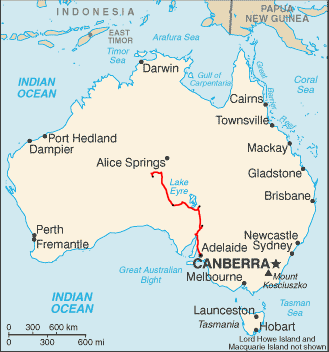 Photos!
In the morning we got a tour of an opal mine by the owner of the campground in Coober Pedy. Like almost everyone else in the town, he spends part of his time mining for opal. He took us through an old opal mine, showed us how opal forms, how one goes about prospecting for it, staking a claim, and mining for it. He showed us the explosives they use for blasting and let us try divining rods, which apparently work for likely opal deposits as well as water. And they actually work! I never thought there was any science behind those things, but it turns out they really work. No pictures from this part, sorry.
We spent most of the day after that driving. Our destination for the night was a bush camp on the Mt. Conner cattle station. Cattle raising in Australia is profitable because many of the plants have very high protein levels, so cattle raised on them is healthier or tastier or something. Of course, at other times the cyanide levels in those same plants gets too high, killing the cattle that eat them. Not to mention all the other ways cattle can die in the outback. Cattle stations in the outback are usually enormous. The biggest Australian cattle station, Anna Creek, is six million acres - bigger than Belgium and four times as large as the biggest cattle ranch in the U.S.
At the bush camp we met our host, Ian, the owner of the cattle station. He was a very cool guy (must run with the name). He was the quintessential hardy outback type, friendly but soft spoken and a man of few words, knowledgeable and tough enough to enjoy living out where life is still very hard. Around the campfire he obliged us by telling us all about the different ways one could die in the outback. Besides the usual venomous snakes and spiders, other highlights included a type of wood that will give you gangrene within 12 hours from a splinter, and bullet ants, enormous (I mean enormous) ants with the most painful sting of any insect in the world. Oh good. His wife told us about the time a Common Brown Snake (euphemistically named, as it is horribly venomous) slithered into the outhouse she was using, and she had to sit there with the snake wrapped around her ankles until it decided to leave. They also told us about the various rescue operations they had been involved in, including a Checkoslovakian couple who were never found ("Yeah, they're still out there somewhere," chuckling) and a hiker Ian singlehandedly tracked and rescued ("I'm not sure he was all there in the head").

The next morning (okay, technically day five, but it fits better in here), Ian took us out on a walk to see the sun rise on Mount Conner, which was very pretty. He also showed us a lot of different plants and other features of the landscape (Ian: "This here is a bullet ant nest. They're all still inside the nest at this time of morning, but I'll poke it with this stick so some of them will come out." Everyone else: "Uhhh...."). You could tell from the way he talked that Ian truly enjoyed the land and his work.
Side note: For a good time, read about the Schmidt Pain Index for insect stings (on which bullet ants receive the highest rating). The descriptions are fantastic, and the story of the index's origin is pretty funny too. Entomologists are a strange breed.
Subscribe to:
Posts (Atom)